The Magic of Montessori at Home: Gentle Ways to Grow Independence and Joy
The idea of bringing Montessori into your home often sounds like a neat Pinterest board — perfectly arranged trays, wooden toys, and a calm, quiet corner for “work.” But Montessori at home is far more than aesthetics. It’s a way to tune into how children naturally learn, and to shape a household that encourages curiosity, independence, and deep concentration. Whether you are a new parent, a tired caregiver searching for structure, or a curious educator, this guide will walk you through practical, realistic ways to make Montessori principles part of your everyday life.
Let’s dispel one myth right away: Montessori is not only for wealthy families or formal classrooms. Montessori at home can be simple, affordable, and deeply effective. You’ll learn how to create a prepared environment, pick and make Montessori materials, plan Montessori activities that fit your family rhythm, and foster self-directed learning without stress. I’ll also share common pitfalls and how to adapt Montessori for small spaces, busy schedules, and siblings of different ages. By the end you’ll feel equipped to try a few meaningful changes that invite learning, not force it.
What Montessori at Home Really Means
When people first hear “Montessori,” they often picture a classroom with round rugs and wooden puzzles. That image captures part of it, but the heart of Montessori is a philosophy: respect for the child as an active learner, and belief that children learn best through hands-on exploration and choice. Montessori at home adapts that philosophy to family life. It’s about designing your space and routines so children can move, choose, and learn safely and independently.
Montessori at home emphasizes the prepared environment — a space arranged to match a child’s size and abilities. This means low shelves, child-sized utensils, reachable hooks for jackets, and activities presented at the child’s level. A prepared environment is not clutter-free for aesthetics; it’s intentionally arranged so children can focus, return to activities, and build self-confidence. In this environment, adults step back from instructing and instead observe, guide, and scaffold when needed.
At its core, Montessori at home celebrates child-led learning. That doesn’t mean children do whatever they want all the time. It means adults carefully offer choices and materials aligned with developmental goals, then let children explore at their own pace. Through repetition, concentration, and gradually increasing challenges, children master skills and internalize self-discipline without external pressure.
Core Principles to Hold Close
Before we jump into shelves and trays, it helps to anchor ourselves in a few core principles that shape every Montessori decision you’ll make at home. These ideas guide how you choose materials, structure routines, and respond to behavior.
– Respect for the child: Treat children as capable individuals with preferences, emotions, and an internal drive to learn. Speak to them kindly, give them time, and create opportunities to make meaningful choices.
– Prepared environment: Arrange your home so that it invites independence and minimizes adult intervention. Think accessibility, order, and beauty.
– Observation over interruption: Watch to learn what a child needs. Observation tells you when to introduce a new challenge and when to step in.
– Practical life first: Start with activities that support daily living — pouring, dressing, cleaning — because these build coordination, concentration, and confidence.
– Sensitive guidance: Offer gentle limits and clear expectations. Montessori discipline focuses on intrinsic motivation rather than reward and punishment.
These principles don’t demand perfection. They invite steady, mindful changes that make daily life more peaceful and empowering.
Designing the Montessori Prepared Environment
A prepared environment is the backbone of Montessori at home. You don’t need to remodel your house. Small changes in organization and accessibility make a huge difference. Think of your home as a workshop where each area has a purpose and the child’s needs are anticipated.
Start with these practical ideas that work in apartments and houses alike:
– Low shelves for toys and learning materials so children can choose and return items.
– A child-sized table and chairs for activities and meals.
– A cozy reading nook with books arranged facing out.
– Hooks at child height for coats and bags, and a low mirror for self-dressing practice.
– A small broom, dustpan, and sponge for practical life tasks.
These adjustments send a powerful message: you trust the child. This trust breeds confidence, and confidence fosters more learning.
Organizing Materials: Less is More
Montessori materials are purposeful. They invite focused work and allow repetition. That means a fewer number of well-chosen activities is better than a crowded shelf. Rotate materials to maintain novelty but keep each offering simple. When a shelf is tidy and uncluttered, children can choose without overwhelm and concentrate longer.
A helpful rule: have one material per developmental aim. If you want to support fine motor skills, provide bead threading, a tweezing activity, and a simple tool-use tray, but not ten similar items. Observe which materials support deep work and which are played with briefly; adjust accordingly.
Example Shelf Setup for a Toddler
| Area | Materials | Goal |
|---|---|---|
| Practical Life | Pouring set, sponge, small broom | Coordination, independence |
| Sensorial | Color tablets, texture cards | Sensory discrimination |
| Language | Picture books, object baskets | Vocabulary, listening |
| Math | Counting beads, number cards | One-to-one correspondence |
| Art/Creative | Crayons, paper, scissors | Self-expression |
This modest setup supports a wide range of learning. Notice how practical life sits alongside sensorial and cognitive activities; Montessori at home does not privilege academics over daily living — both matter.
Practical Life Activities: The Unseen Superpower
If there’s a secret sauce in Montessori at home, it’s practical life activities. These are everyday tasks — pouring water, wiping a table, buttoning a shirt — that adults often do for children. When children practice these tasks themselves, they develop concentration, fine motor control, independence, and a sense of dignity.
Practical life activities might look boring to an adult, but for a child they are meaningful and purposeful. Each activity has a clear beginning and end, a sequence of steps, and a tangible result. That structure supports attention and decision-making.
Simple Practical Life Ideas to Start Today
- Pouring water between two small pitchers (use a tray and do it over a towel).
- Transferring beans or pasta with a spoon or tongs to learn coordination.
- Washing fruits or vegetables at a child-height sink with a small colander and towel.
- Buttoning and zipping frames for dressing practice.
- Setting the table with placemats, utensils, and cups.
- Wiping the table after meals with a sponge and small basin.
Each activity needs a clear demonstration at first. Show slowly, with neutral language, and then step back. If a child spills, resist rushing in to fix it. Spills become chances to practice cleaning up and learning that mistakes are manageable.
How Practical Life Builds Independence
Practical life activities give children agency in their world. When they can make a snack, put on their shoes, or sweep crumbs, they rely less on adults and feel capable. This independence reduces power struggles and increases cooperation. Over time, children take pride in contributing to family life — a core Montessori value.
Practical life also scaffolds academic learning. Skills like pouring and spooning train the hand for writing; sorting and matching help with math; sequence-following prepares children for complex tasks later. In short, these “simple chores” are secret lessons in cognition and self-regulation.
Sensory Play and Sensorial Learning
Montessori places strong emphasis on sensory education because the senses are the child’s first tools for understanding the world. Sensory or sensorial activities refine perception — color, weight, texture, shape, and sound — and build vocabulary and discrimination skills.
Sensory play is not messy for its own sake. It’s purposeful, with materials chosen to highlight one quality at a time. Children learn to notice subtle differences, which supports later academic concepts like letters, numbers, and scientific observation.
Sensorial Activities to Explore
- Texture boxes with rough, smooth, and soft materials; ask the child to match by touch.
- Sound cylinders or matching bells for auditory discrimination.
- Color tablet matching and gradient games to explore hues.
- Weight scales with similar-sized objects of different weights to explore balance.
- Taste tests with small, safe bites (sweet, salty, sour) while discussing flavors.
Use trays and small bowls to keep things organized. When children can compare and label their sensations, they hone observation and language skills simultaneously.
Montessori Materials: Buy, Borrow, or DIY?
Montessori materials have a reputation for being expensive, but you don’t need a full classroom set to succeed. The goal is not to replicate everything Maria Montessori designed; the goal is to offer thoughtful materials that invite concentration and learning.
If you have budget, investing in a few authentic wooden materials can be lovely. If you don’t, many Montessori activities are easily made from household items: jars, spoons, cloth, bottles, and boxes. Libraries, community schools, and online groups often have second-hand materials for sale or trade.
Key Items Worth Investing In
| Material | Why It’s Useful | DIY Option |
|---|---|---|
| Puzzles (wooden, inset) | Fine motor and problem solving | Make simple knobbed puzzles from cardboard and dowels |
| Bead chains or counting beads | Concrete math exploration | String beads on pipe cleaners or cord |
| Practical life sets (sponge, pitchers) | Independence and coordination | Use small pitchers and funnels from the kitchen |
| Metal tongs and tweezers | Fine motor strength | Use kitchen tongs for larger transfers |
When you buy, choose durable materials with calm colors and clear purpose. Avoid toys that light up, make chaotic sounds, or require batteries — these often distract rather than engage.
Montessori Activities by Age Group
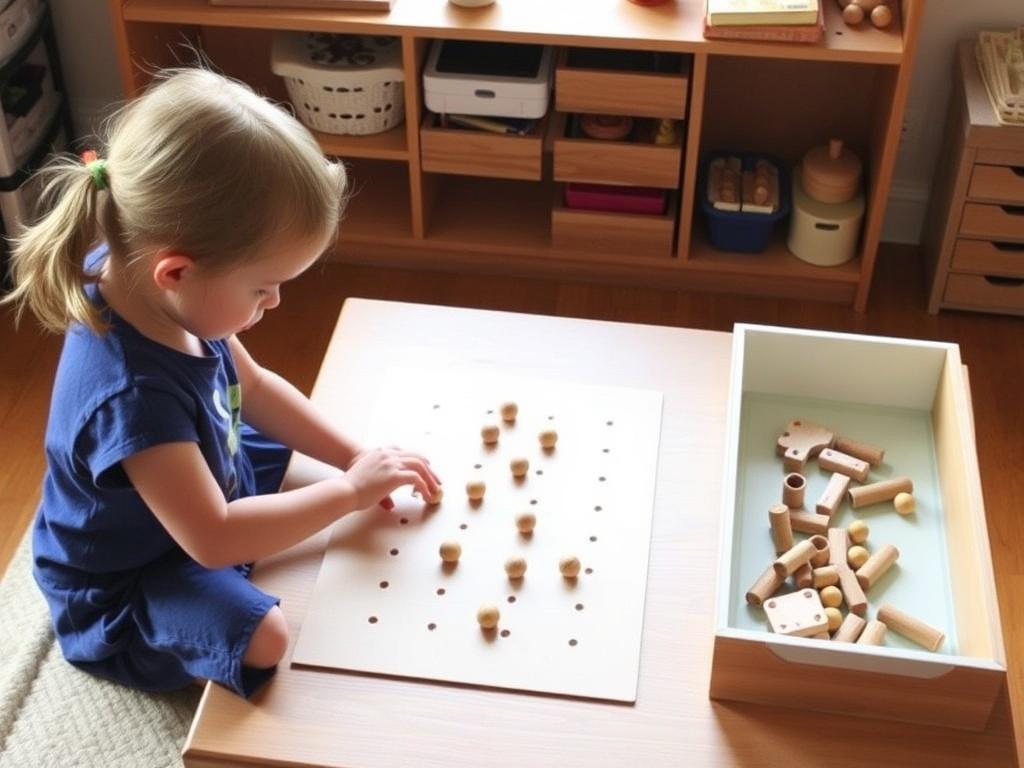
One of the strengths of Montessori at home is that activities naturally scale with a child’s development. Here are practical suggestions across ages, designed to build skills progressively.
0–18 Months: The Foundation of Movement and Security
In infancy, the major tasks are movement and sensory exploration. Create safe spaces for tummy time, crawling, and standing. Offer objects of different textures and sizes, sturdy low furniture for cruising, and a consistent daily rhythm.
Activities:
- Object baskets with safe, interesting items.
- Cloth books and simple board books turned face-out.
- Low mirror for self-discovery.
18 Months–3 Years: Practical Life and Language Bloom
Toddlers crave involvement. This is the golden age for practical life activities, self-dressing practice, and language-building.
Activities:
- Pouring and spooning exercises.
- Simple matching games and picture-labeling.
- Start introducing number words through routines (counting steps, fruits).
3–6 Years: Concentration and Sensorial Refinement
Preschoolers can handle multi-step tasks and more abstract sensorial materials. This is the classic Montessori classroom age and a great time for more structured shelf work.
Activities:
- Sorting, sequencing, and patterning with beads or natural objects.
- Letter sounds with tactile letters and object matching.
- Practical life tasks that involve planning (preparing a snack).
6–12 Years: Independence, Projects, and Deep Work
Elementary-aged children benefit from longer projects and opportunities to explore interests. Encourage research, hands-on experiments, and responsibilities around the home.
Activities:
- Gardening, cooking, and woodworking projects.
- Math with manipulatives moving toward abstract problems.
- Community projects, volunteering, and mixed-age mentoring.
These age suggestions are flexible. Observe your child and adapt. Montessori at home is not about hitting milestones on a calendar; it’s about following a child’s developmental cues.
Daily Rhythm and Routines That Support Montessori Learning
Children thrive on predictable rhythms. A Montessori-inspired routine balances child-led work periods with outdoor play, meals, and quiet time. The goal is not rigidity but a reliable flow that allows deep focus.
A simple daily rhythm might look like this:
- Morning: Arrival, practical life (dress, breakfast), independent shelf work.
- Midday: Outdoor play, lunch, shared chores and conversation.
- Afternoon: Rest or quiet time, project-based work or guided activity.
- Evening: Family meal, bedtime routine, story time.
Long uninterrupted work periods (45–90 minutes for older children, shorter for toddlers) let children dive deep. Adults can protect these periods by minimizing interruptions and offering quiet companionship when needed.
Balancing Structured and Unstructured Time
Montessori at home is deceptively structured: you prepare the environment and offer predictable routines, but within those boundaries children choose their work. This blend of structure and freedom fosters self-regulation. If your child resists a routine, observe — are the materials engaging? Is there too much or too little novelty? Adjust gently.
Common Challenges and How to Solve Them
No approach is perfect for every family. Here are common obstacles and practical ways to address them.
“I’m not sure what to offer; where do I start?”
Begin with practical life. Set out a pouring activity, a simple book corner, and a low shelf with two or three sensorial items. Observe for a week and note what holds your child’s attention. Build from there.
“We don’t have space for a dedicated Montessori room.”
You don’t need a full room. Use a corner of a living room or a portable cart with trays you can wheel out during work periods. Low baskets under a coffee table can double as shelves. The prepared environment is about accessibility, not square footage.
“My child ignores the activities.”
Try reducing the number of choices. Overwhelming shelves can lead to paralysis. Present a single interesting activity and sit nearby to gently invite engagement. Sometimes the child needs a short demonstration or a calm invitation: “Would you like to try this pour with me?”
“How do I handle tantrums and strong emotions?”
Montessori encourages emotional coaching and respectful limits. When a child is upset, first ensure safety, then label feelings: “You seem very angry.” Offer a quiet space, a calming routine (deep breaths, a cozy blanket), and later, problem-solve together. Avoid punishment; instead, restore and teach.
Montessori for Siblings and Mixed-Age Families
One of Montessori’s strengths is how it naturally supports mixed-age interactions. Older siblings model behaviors, mentor younger ones, and gain leadership skills. Younger children benefit from observing more advanced work. At home, rotate shelf offerings so there are activities suitable for different ages.
Create clear expectations for sharing and safety. Keep fragile materials out of reach of younger children, and offer parallel activities so everyone can work independently without competition.
Tips for Mixed-Age Households
- Have duplicate basic practical life materials to reduce conflict (two small pitchers, two sets of utensils).
- Designate a “quiet work” shelf with items meant for concentration and model how to respect that space.
- Encourage older children to teach simple activities; teaching consolidates their own learning.
Mixed-age groups mirror the real world and require negotiation skills — a wonderful opportunity for social learning.
Montessori and Technology: Finding Balance
Montessori at home does not require abandoning screens, but it calls for careful limits. Screens can be passive and overstimulating, undermining the deep concentration Montessori seeks. If you choose to use technology, make it intentional: short, high-quality, educational activities that encourage creation over consumption.
Set clear rules: no screens during work periods, limited screen time based on age, and always co-view or co-play to turn technology into shared learning. Prioritize hands-on materials and real-world interactions over virtual ones.
How to Observe and Assess Without Testing
Montessori relies on observation rather than frequent testing. At home, this means watching to see what activities a child chooses, how long they concentrate, and where they need support. Keep a simple notebook or phone note with observations: what engaged them, what frustrated them, and what skills are emerging.
Over time, patterns reveal readiness for new challenges. If a child spends weeks mastering pouring without spills, offer a finer motor challenge like spooning beads. If they show interest in letters but not sounds, follow their curiosity and add tactile letters or sound games.
Adapting Montessori to Your Values and Culture

Montessori is not a one-size-fits-all doctrine. It should harmonize with your family culture and values. If your household is loud and lively, don’t force unnatural quiet; instead, offer distinct spaces for concentration and for play. If extended family helps with caregiving, share a simple guide explaining the prepared environment and gentle guidance techniques so everyone can support the child consistently.
Montessori at home is about respect, not rigidity. Adapt materials to reflect your language, traditions, and family rhythms. Celebrate cultural crafts, songs, and food as part of learning.
Resources and Communities
You don’t have to go it alone. Many communities offer parent workshops, Montessori playgroups, and online forums where families share DIY ideas and troubleshoot. Libraries and community centers often host free events that align beautifully with Montessori values — story times, craft sessions, and nature walks.
Books to consider:
- Maria Montessori’s classic works for philosophical grounding.
- Parent-friendly guides with practical activities and shelf setups.
- Blogs and podcasts by Montessori educators who focus on home application.
Seek out local secondhand groups for affordable materials. Co-ops and swap meets can make authentic materials accessible.
Real-Life Examples: Small Changes, Big Impact
Stories help make this approach tangible. Imagine a small apartment where a mother transforms a low bookshelf into a toddler’s accessible learning area. She starts with a pouring set, a set of board books facing out, and a basket of stacking cups. Within a week, the toddler pours with concentration, uses new words, and begins to help put away toys. The family’s mealtime improves because the child can set a placemat and carry their cup.
In another home, a busy father sets up a weekday 30-minute “work basket” ritual with his preschooler: a tray with a simple matching game and a pencil-and-paper activity. The child learns that there is an adult time for work and then free play. Over months, the child increases focus and shows interest in longer tasks.
These stories show how small, intentional changes to environment and routine, not grand overhauls, create real learning.
Checklist to Start Your Montessori at Home Journey
| Step | Action | Why It Helps |
|---|---|---|
| Observe | Watch your child for a few days without changing anything | Understand interests and rhythms |
| Clear a small area | Choose a corner for low shelves and a chair | Creates a predictable workspace |
| Choose 3–5 materials | Pick a pouring set, a sensorial activity, and books | Prevents overwhelm and encourages focus |
| Introduce | Demonstrate each activity slowly | Sets clear expectations for use |
| Protect work time | Offer 30–60 minute periods of uninterrupted work | Encourages concentration |
This checklist can be accomplished in a weekend. The most important step is to start small and observe often.
Common Myths About Montessori at Home
Let’s bust a few myths that keep families from trying Montessori practices.
Myth 1: Montessori is expensive and requires special furniture.
Fact: Many Montessori activities use recycled or household items. Low shelves and simple trays are affordable.
Myth 2: Montessori means no structure or rules.
Fact: Montessori balances freedom with clear, consistent boundaries. The structure supports freedom.
Myth 3: Montessori is only for preschoolers.
Fact: Montessori principles apply from infancy through adolescence. The materials and activities simply mature with the child.
Understanding these myths helps parents move past perfectionism and try practical steps.
How to Measure Success Without Tests
Success in Montessori at home isn’t measured by flashcards or worksheets. Look for signs of deep concentration, increasing independence, willingness to help, and curiosity. If your child can complete multi-step tasks, manage frustration, and show care for materials, you’re seeing the fruits of Montessori living.
Keep an eye on social and emotional signs too: empathy, patience with younger siblings, and the ability to negotiate are all important markers.
Putting It All Together: A Week of Montessori-Inspired Activities
Here’s a sample week to give you an idea of how to blend practical life, sensorial, language, and outdoor learning into a family rhythm.
Day 1: Practical Life focus — pouring practice, setting the table, washing fruit.
Day 2: Sensorial focus — color matching, texture walk outdoors, listening games.
Day 3: Language focus — storytelling with props, letter sounds with tactile letters.
Day 4: Math focus — counting nature finds, bead stringing, sorting snacks by size.
Day 5: Project day — simple cooking with measuring; tidy-up routine with checklists.
Day 6: Community day — visit library, do a neighborhood clean-up with small tools.
Day 7: Reflection and free exploration — open choice day to follow the child’s lead.
Rotate themes according to your child’s interest. The point is variety within a predictable rhythm.
Final Thoughts Before You Begin
Montessori at home is less a program and more a mindset. It invites you to see children as competent, curious beings and to arrange your home so those qualities can flourish. Start small, observe, and be kind to yourself. You don’t need a perfect shelf or a degree in education — you need consistency, patience, and trust in the child’s capacity to learn.
If you’re worried about losing control or letting kids “do whatever,” remember the structure is there: predictable routines, clear expectations, and gentle guidance. The magic is that when children are given trust and tools, they typically step up to the invitation.
Conclusion
Bringing Montessori into your home is a journey of small, intentional shifts — creating accessible spaces, offering meaningful Montessori activities, emphasizing practical life and sensory learning, and trusting children’s natural curiosity. The results are not instant miracles but steady growth: more independence, deeper concentration, and a calmer, more cooperative family life. Start with one shelf, one tray, or one routine, observe how your child responds, and build from there. Montessori at home is less about perfection and more about creating a respectful, prepared environment where children can explore, fail safely, and discover their own love of learning.